


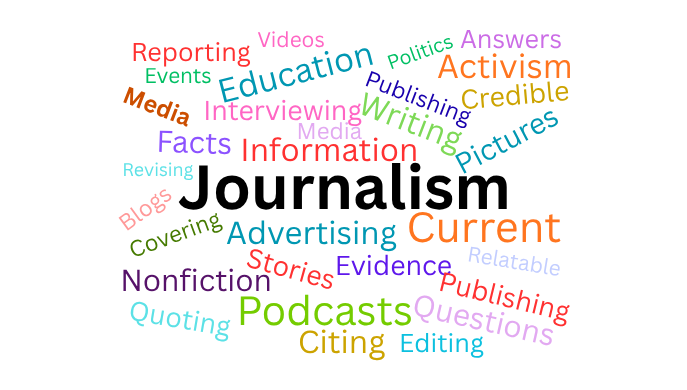
Journalism plays an essential role in the community so people can stay informed with what is happening around them.
It presents stories that serve a purpose to the community by presenting factual information as quickly as possible. From school newspapers to major news outlets, journalism is heavily misunderstood for what it really does for society. Journalists are frequently targeted, receiving backlash and harsh criticism for their work.
Journalism is the process of gathering, interviewing, confirming, and presenting information through articles, newspapers, blogs, podcasts, magazines, and other forms of media. There are many topics that journalists write about such as schools, community updates, world news, sports, entertainment, etc.
I am a reporter for Brunswick High School’s, Garnet & Gold Gazette. I have been in journalism for the past two years and have faced countless issues and backlash on my articles, specifically on the ones about my school.
When writing about the school, or any content that may be controversial, it is nearly impossible to avoid complications and scathing attacks on articles.
One of the biggest misconceptions for so many news consumers is many people believe that journalism is entirely biased.
Viewers and readers may disagree with a headline or statement and feel uncomfortable with what you are saying as a reporter. This is because it can be hard for readers to differentiate between true facts and opinions.
In a survey conducted by YouGov, a group of participants were given twelve statements, and asked to determine whether it was a fact or an opinion. The average amount of people who were able to answer correctly was only 59.9% of the test group. This proves how many people can struggle to differentiate factual reporting from personal opinion.
Many journalists choose to write about topics that they have had personal experience in or have been impacted by in life.
Just because they have personal experiences does not automatically make their work entirely opinionated because they still have to go through the process of gathering factual information and conducting interviews. Real journalism requires for claims to be supported by facts and not emotions. Reporters must keep their personal bias out of what is shared with the public.
Another misconception is that people believe journalism should only cover the positive stories.
If journalists only wrote about the happy uplifting topics none of the important problems would be addressed. The point of journalism is to reflect on reality to speak up on current matters so that more people become aware of issues within society and their communities.
Another misunderstanding reporters face is how the interviewing process works.
It is essential for journalists to interview people that have firsthand knowledge and experience on the topic. This helps to add credibility to articles, but it can also be the most challenging as you have to quote them correctly and respectively. When someone agrees to be interviewed it is essential for them to understand how their words may appear in an article.
There are three different types of quotes journalists can use in Associated Press (AP) style:
- Direct quotes: Exact words spoken, which are placed inside quotation marks.
- Indirect quotes: Paraphrased quotes without any quotation marks.
- Partial quotes: A combination of direct and indirect quotes to paraphrase what was said, leaving the most important parts left in quotation marks.
When going through the interviewing process, some journalists choose to send their finished article to whoever they interviewed. The purpose of this is to give the interviewee the opportunity to make any changes to how they were quoted so that they feel fairly represented and treated.
There will always be people who critique how a reporter quoted them as they may have wanted them to use their entire quote or highlight a different part of what they said. Depending on the topic of the article, some may see it as a personal attack. However, as long as the journalist quotes their sources appropriately and accurately within the context of the interview, it is not required of them to protect someone’s image or feelings when they have given them the consent to be interviewed.
If you are ever being interviewed it is important for you to communicate if you do not want to be interviewed and share any questions or concerns you may have about how your words are going to be used. Most respectable reporters will share the final draft of an article before publication for this exact interaction.
Journalism is expanding with the use of social media as it is becoming more accessible and easier to share with others. As journalism continues to grow more and more people begin to not understand what journalism really is for society. It allows for people to speak up for what they believe in and make a difference.
The ultimate purpose of journalism is to give people trustworthy and timely information to engage the public with what is happening around them, not creating hateful comments about journalists and diminishing the purpose.
Carlee Poole • May 22, 2026 at 10:09 am
This is an incredible article! I really like the way you put in the three different types of quotes journalists can use. Plus adding in the question with challenges we face is really important to show what writers have to deal with sometimes.
Morgan • May 20, 2026 at 10:02 am
I really like how this article is informative and detailed. I think it has a lot of coverage and really shows the depth of journalism. This is very well done!
Aubrey Kannegiesser • May 20, 2026 at 8:23 am
I really like this article and how informational it is. Not a lot of people know the entire process and how long it can take just for interview questions or getting the perfect cover photo. Nice article!