


































Black History Month in 2026 has brought both celebration and controversy across the United States.
While communities nationwide hosted parades, school programs, museum exhibits, and cultural performances honoring African American history, political debates at the national level sparked concerns among civil rights groups about how Black history is recognized and supported.
Black History Month was first established as Negro History week in 1926 by historian Carter G. Woodson.
The advocacy was expanded to a month-long observance in 1976 during the presidency of Gerald Ford. Since then, every U.S. president has formally recognized February as a time to honor the achievements and contributions of African Americans.
Positive Impacts in 2026
Despite political tension, many organizations reported record participation in Black History Month events this year. The Smithsonian National Museum of African American History and Culture hosted expanded programming, including youth leadership workshops and historical exhibits focused on civil rights milestones.
In cities like Atlanta and Chicago attendance and participation in events has increased over the last few years, with community groups offering support. It shows the increase of care, acknowledgement, and interest of Black history, showing support and decreasing political and racial disagreements.
For example schools across the country continued to teach lessons highlighting leaders such as Martin Luther King Jr., Rosa Parks, Thurgood Marshall, and many other examples of impacting African Americans in history. Many educators emphasized themes of resilience, innovation, and civil engagement.
Criticism and Political Debate
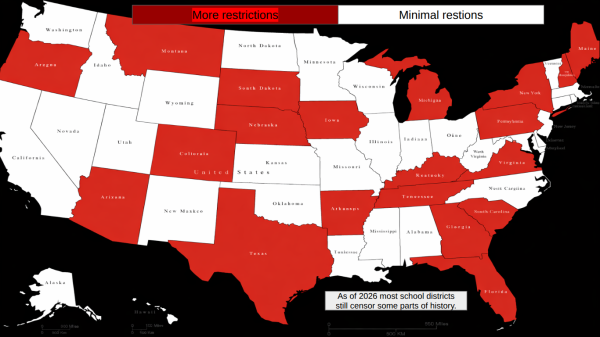
Federal policy and public statements have affected how Black history is discussed in schools or government institutions. Organizations such as the National Association for the Advancement of Colored People (NAACP) showed concern that limitations on certain educational topics could restrict discussions about systemic racism and the historical experiences of African Americans. Over 18 schools such as Florida, Texas, Oklahoma, Tennessee, and Idaho have passed restriction laws on how slavery, Black History is taught.
It’s clear how each of these states are Republican.
Some reasons that were said why the restriction is put in place is for the students of White color so they don’t feel “guilt” “discomfort” “shame” but some controversy’s explain how its to blatantly cover up racism. There’s no reason not to teach history, if children aren’t going to learn everything, it defeats the purpose of education. Sure, there is some things children should be kept from knowing but as they get older they turn into young adults which need to learn more about the world. The ones who died just cause the color of their skin. It’s nonsense to cover up the past, if they are what’s the point of even teaching history? All the shame of the United States should be buried with all the other stuff they leave out. Even blue states or states who don’t restrict still keep things out of lessons, the harsh, cruel things. If kids are there to learn why hide what’s true.
More backlash for this Black History Month relates to the President of the United States.
The President has shown various examples of hate and racism.
The Trump Administration has posted a video of Donald J. Trump back lashing on the former president Barack Obama and the former first lady Michelle Obama comparing them as “apes.”
Even senators such as Tim Scott (South Carolina) disagree with this statement stating that it’s “the most racist thing I’ve seen in this white house.” Trump declined to apologize dismissing the backlash as jokes or over reactions.
Just two days ago, Feb 25, 2026 Trump stated that state representative Ilhan Omar and Rashida Tlaib should be sent from “where they came from” or should be “institutionalized”. You can’t see the facts and say that Trump is a decent human being. Keep in mind, he is an immigrant himself with his grandfather Friedrich Trump and grandmother Elisabeth Christ being from Germany. Not only that but his mother Mary Anne MacLeod is an immigrant coming from Scotland moving to the U.S in 1930 only 15 years before Donald J. Trump’s birth.
Public Response
Adding to what was stated earlier people’s options differ political, racial, ethical, it all depends on your roots, how you are as a person, where you grew up, what you grew up with and just if well educated or not.
Some may ask why there’s no White history month, they don’t take for understanding that each month is a White persons month, Black History month or any of the other heritage months are to highlight the races that are in the dark or misunderstood, that’s what Carter G. Woodson was trying to make others see, the hard work or colored people being dismissed, not saying that whites aren’t hard working or anything like that no, these months were made to give colored people a chance. In the start Black History was call “Negro History Week,” clearly this itself shows how Blacks couldn’t even get a month of accommodation let alone it be called something proper or appropriate.
Sociologists point out that presidential messaging can impact how cultural observances are perceived. While no formal repeal of Black History Month has occurred, debates over funding, curriculum standards, and public statements have shaped this year’s national conversation.
Black History Month 2027
With everything going on in the world with the Trump administration talking away national memorials of Black History or removing names of Black soldiers, its not looking great so far, with controversies of the removal of Black History month or any month dedicated to races such as as Asian Heritage and Pacific Islander month (May), Hispanic Heritage month (Sep 15 to Oct 15). It’s important to treat all races equally because at the end of the day we were all human with different stories, the same person but different lives.