




















AI Affecting Modern Society’s Creativity & Thinking Skills
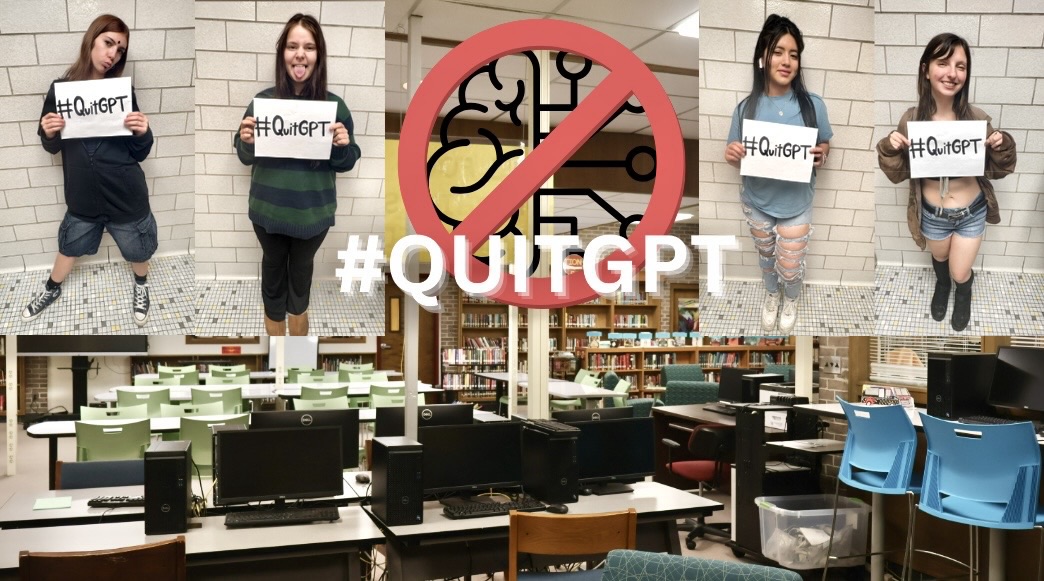
Artificial intelligence (AI) tools such as ChatGPT, image generators, and automated writing programs have rapidly become part of everyday life. Students, workers, and creators increasingly use AI to research information, write text, and generate ideas. While these tools improve efficiency and productivity, many argue that they may weaken human creativity and critical thinking skills. This debate has even sparked online movements such as #QuitGPT, where people call for limiting AI use in order to protect human originality and independent thinking.
“Screw ChatGPT, it’s killing the polar bears.”
—Teirra Lynn (Junior at BHS)
AI & the Decline of Critical Thinking
One of the most common concerns about AI is that it may reduce people’s ability to think deeply on their own. When AI provides quick answers or fully written responses, users may rely on the tool instead of analyzing information themselves. According to a study conducted by researchers at the MIT Media Lab, participants who used AI tools to write essays showed lower brain engagement and weaker memory recall compared with those who wrote without AI assistance.
Similarly, organizations such as the Organization for Economic Co-operation and Development, (OECD) also warn that generative AI can create what researchers call a “false mastery” of knowledge. Students may appear to perform well because AI generates answers, but they may not fully understand the material themselves.
Because critical thinking develops through practice, analyzing information, evaluating sources, and forming arguments, excessive reliance on AI could weaken these mental skills over time.
AI’s Influence on Creativity
Another major debate focuses on whether AI harms human creativity. Creativity involves generating original ideas, experimenting with possibilities, and learning through mistakes. Some research suggests that AI may influence how people develop and create ideas.
For example, research from the Wharton School of the University of Pennsylvania found that while AI tools can improve the quality of individual ideas, they can also cause people in groups to produce more similar ideas, reducing the diversity of thinking that drives innovation.
A large experimental study on human–AI brainstorming found a similar pattern. Exposure to AI-generated ideas did not necessarily improve individual creativity but did change how ideas evolved collectively, often making them less diverse.
However, not all research shows negative effects. Mixed findings suggest that AI does not automatically destroy creativity but can influence how creative ideas are produced and shared.
The #QuitGPT Movement & Cultural Debate
The concerns about AI’s effects on thinking and creativity have led to online backlash against generative AI tools. The hashtag #QuitGPT represents a growing movement of people who believe that heavy AI use could harm human skills, academic integrity, and artistic originality. Critics argue that if AI becomes the primary source of writing, art, and research, society may lose the practice of creative problem-solving and independent thought.
The hashtag #QuitGPT began appearing on social media in the early 2020s after generative artificial intelligence tools like ChatGPT became widely available. As more students, writers, and professionals started using AI to generate essays, artwork, and research summaries, some people online began questioning how this technology might affect human creativity and independent thinking. The hashtag became a way for critics to encourage people to reduce their reliance on AI tools and focus on producing their own ideas and work. Although #QuitGPT is not an official organization or movement, it represents a growing online discussion about whether artificial intelligence is helping or harming society.
Supporters of AI, however, argue that the technology is simply a tool, similar to calculators, search engines, or word processors. They believe AI can enhance creativity by helping people brainstorm ideas, explore different perspectives, and overcome language barriers. Research shows that when humans collaborate with AI rather than relying on it completely, their creative performance can actually improve.
This debate reflects a broader cultural question: whether AI will replace human thinking or simply transform how humans create and solve problems.

The impact of AI on creativity and thinking skills will depend on how society chooses to use it. When used responsibly—as a tool to assist rather than replace human effort—AI has the potential to support innovation and learning.
If individuals rely on it too heavily, the long-term consequences could include reduced originality, weaker analytical skills, and a decline in independent thinking. The discussion around #QuitGPT reflects a broader debate about the role of artificial intelligence in modern society. Some people believe limiting AI use is necessary to protect human creativity and independent thinking, while others argue that AI can be a valuable tool when used responsibly.
As AI technology continues to grow, societies around the world will need to find a balance between taking advantage of new innovations and maintaining the critical thinking and creative skills that humans have always relied on.